
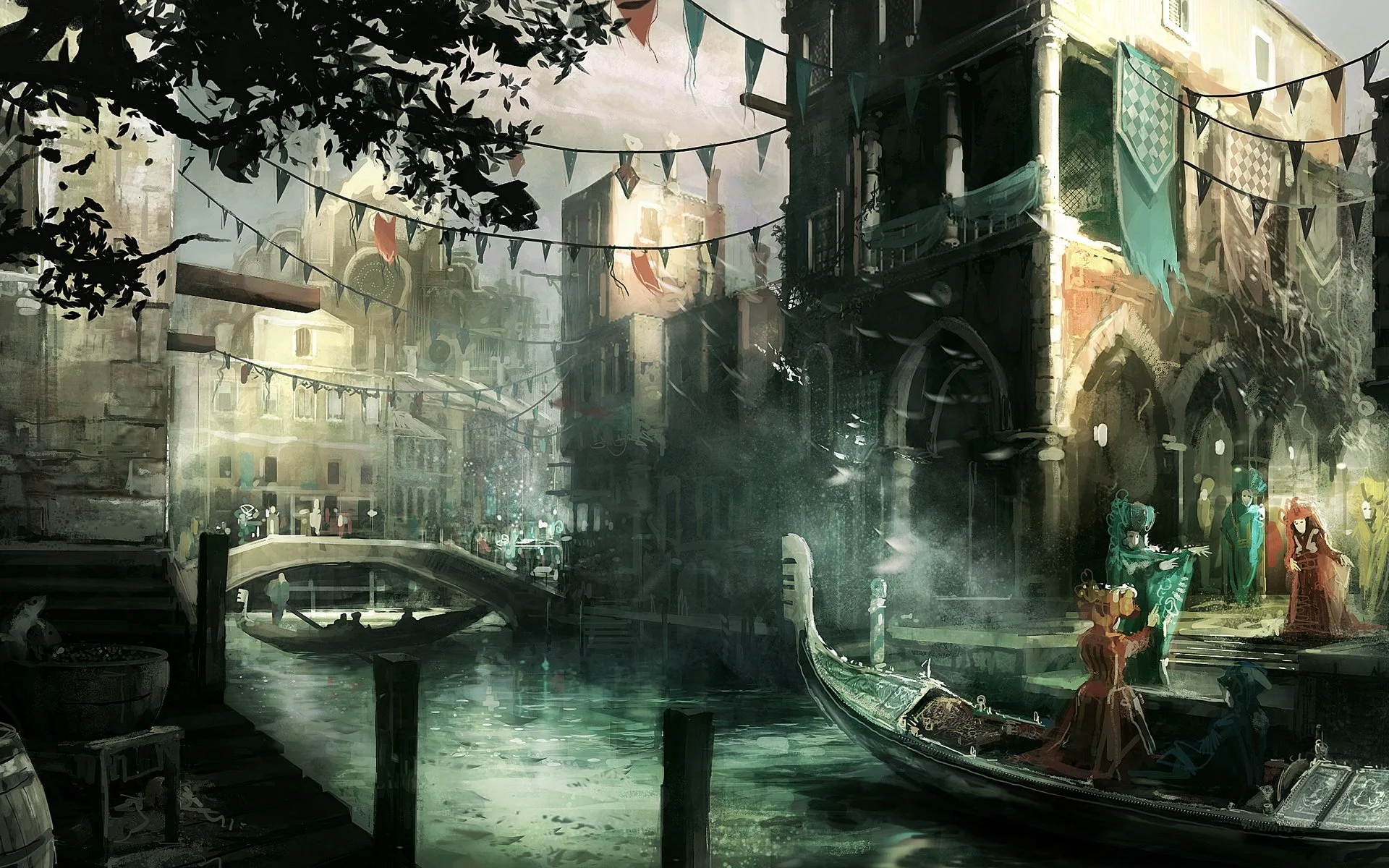
The Ballad of Venice
When painter Tomaso Russo arrives with a letter that was never meant for him, he finds a city shaped by recognition, reputation, and performance. Beneath its masks and galas, prestige circulates like currency.
When he is granted a stage he did not seek, and a curator finds himself hosting an event he never approved, something in the city begins to shift – not loudly, but decisively.
Not every work conforms.
Not every melody remains confined to the stage.
-
I extend my greetings from the north and beg your pardon for my sudden departure. Circumstances of duty required my attention with little notice, and I was compelled to follow where they led.
I do not regret the decision. I cannot say why this place suits me, only that it does. No one here troubles himself much with where a man has come from, and many seem uncertain of their own beginnings.
I find that my work progresses steadily. There is employment enough to keep the hand in practice, and time besides to observe the city’s fondness for music and the arts.
For these reasons, I have resolved to extend my stay, effective immediately. I trust you will understand.I remain,
your devoted friend,
[signature]
He set the letter down. He knew of no one who would write to him in such a manner. Turning it over, he read the name again.Tomaso Russo.
The name was his. The address was not.
This was not the first time it had happened.He straightened himself. With haste-free steps, he moved past the canvas stands cluttering the room. The canvases rested on them in silence. Some bore the beginnings of stories, others remained untouched. None were finished.
He picked up a handful of brushes from the nearby table. They did not need cleaning.
He did it anyway.
Water struck the basin again and again, its sound growing more familiar than the scrape of bristles against cloth.
One of the canvases had been turned on its side. He set it upright again.
It stayed blank.
With a single brush in his hand, he raised it toward one of the canvases. He held it there, the clean tip hovering as though waiting for a response. One after another, he turned the brush upon them, as if waiting for one to falter under the attention. None did. They held their silence.
He lowered the brush. A small, frustrated sound left him, and he sank into the chair nearby, already familiar with the outcome.
As he sat, he watched the light rinse into the room, laying itself across the canvases at uneven angles. None of them aligned in a way that made sense to him. The light shifted faster than his attention could keep pace.
He set the brush down on the desk, conceding the moment. His hand remained there longer than necessary. The letter, still wrongly addressed, drew his attention back.
He read it again.
The place of origin was written plainly on the fold.
Da Venezia. -
Venice 1721
“You have been invited to observe.” He paused. His gaze passed evenly across the room. “I have been entrusted with the care of this collection. On behalf of its benefactors, I will present what has been prepared for your consideration.”He held the words and his posture alike, his attention fixed just above the first rows of seats. For a moment, he occupied the light fully. He remained where he stood, as though awaiting a cue that did not arrive.
Then he stepped back. As he turned, his attention left the room. Behind him, the chairs stood in ordered rows. Empty.
The venue was established and maintained, though seldom sought out. Its scale discouraged distance, the architecture insisting on closeness. Thick drapery lined the walls, muting both sound and light.The room resisted brightness. It revealed only what it chose to.
The creak of a heavy hinge cut into the room’s stillness. Light spilled across the rows of empty chairs as the hall was opened.
“Mr. Valier,” a voice said quietly. “The preparations are complete. The first guests will arrive shortly.” He turned toward the doorway and inclined his head once. His expression did not linger on the messenger long enough to invite further exchange.
The door was closed again at once.
The work of a curatore privato resisted simple definition. Venice required prestige to be maintained and contradictions to be smoothed over. Valier addressed both quietly, through administration. Benefactors depended on such mediation more than they admitted. Reputation demanded constant tending, and appearances did not sustain themselves.
Valier had no claim to nobility. His usefulness lay elsewhere. He understood the seams between social layers and had learned how to move along them without disturbance.His steps echoed through halls that were not his, yet his to host.
He passed a line of servants and raised his mask. One by one, they did the same.He approached the entrance. The door was his to open.
-
Steps in haste and steps without hurry echoed across the countless bridges that held the city together. Gondolas populated the canals, filling the spaces between stone foundations laid long before their passage. Water carried motion where streets could not, threading through alleyways too narrow for anything else. Image, history, and prestige did not rest here. They moved – circulating through canals and corridors alike, sustained by the same restless flow that kept Venice whole. Walls and plazas remembered what moved through them.
In Venice, status circulated. Presence was demanded not by attendance, but by recognition – by being seen, spoken of, and remembered. Trade and art moved through the same corridors. Galas and performances kept the city in motion, carrying reputation ahead of the bodies that followed. Sculptures and paintings flowed like currency, though not for their value alone. Music and plays moved the same way. Theatres were arranged in layers, their curtains drawn differently for each stratum of society. Each layer sustained its own exchanges and expectations, opening doors that were never meant to be seen.
Masks were customary. Faces were arranged as carefully as events, and performance extended well beyond the stage. What was shown took precedence over what was meant, and few expected the two to align.
Art followed the same logic. Paintings expressed, plays commented, banquets convened, and theatres served less as stages for artists than as rooms for those who watched. Little was taken at face value.
On certain evenings, the city even carried music it could not place. The sound did not travel far, yet it lingered longer than it should have. The following days brought no mention of a performance. Conversations shifted regardless.
By day, the city moved at its own pace. Routine filled the hours without concern for who was watching. When the sun set, steps grew fewer and more deliberate. Venice did not sleep, but access narrowed.
Opportunity persisted, but only for those fluent in the city’s currencies. -
It was a table with a fixed number of seats. Not all of them were occupied. The dense wood the table was made out of rested firmly in the center of the room. Two single-shot pistols rested on the table. There was a motionless hand still lying loosely on the grip of one. Silence held the room for a moment. The doors swung open. Two servants with masks on entered the room.
“Non est nostrum videre.”
They removed the body without haste. The chair was cleared. The hand lost its hold. The doors closed.
A pistol was returned to its belt.
“The western district will have to adjust.” the man said.
No one withdrew their hand.
“It was stabilizing. They will feel this before week’s end.”
“The city has begun to favor decisive men.”
“So were they.”
A glance toward the vacant chair.
“It will adjust.”
“It always does.”
“Not indefinitely.”
“Indefinitely is unnecessary.”
Around the table, hands settled close to steel.A breath of amusement.
Heads turned.
He had not moved. His mask carried the faintest suggestion of a grin. His hands were folded before him.
“If the western district requires continuity, I will ensure it.”
No one corrected him.
“Regarding next week’s gathering – how many invitations remain valid?”
The room measured the question.
Ink touched parchment.
The page was folded and sealed.A servant received it without looking up.
It changed hands without pause.
It entered the city like any other instruction. -
The paintings had already been hung up when he entered his office. The man stood now behind his desk, jacket still on, fingers resting against the edge of the polished wood. The room had been arranged for persuasion. The paintings occupied the wall opposite him, positioned carefully between the windows and the shelving.
One of them was wrong. Not damaged. Not incomplete. Wrong.His eyes passed over the others without resistance. They did what they were supposed to do – announce themselves, claim attention, perform importance. He registered their colors, their movement, the way they leaned forward as if already making an argument on his behalf.
The third did not lean. It did not pull.
He found his gaze resting on it without instruction. There was nothing about it that demanded a closer look. No detail that promised reward for attention.
He turned back to his desk. There were matters that required his attention.Work had been moving fast lately. Sleep was sparse. The day was taken by business while the nights demanded social attendance – dinners that ran long, salons held together by obligation, improvised gatherings convened on the strength of little more than a name and a promise of proximity. At least at that level of society, absence had become noticeable.
People no longer spoke of plans. They spoke of deadlines. Contracts were expected to conclude by the following day, sometimes sooner. Decisions were not rushed – they were final. Little space remained for revision once a matter had been placed on the table.
There was money, of course. There was always money. But it no longer lingered. Payments were settled promptly. Accounts closed cleanly. Patronage passed through hands without ceremony, as though remaining unresolved had become undesirable.
A number of names had fallen out of use. Not disgraced. Not replaced. Simply no longer spoken with the expectation of reply. Seats remained empty longer than etiquette allowed, then were filled without comment. Correspondence ceased. Obligations were redistributed. No one objected.He had the faint impression that the city itself had grown impatient.
A careful knock sounded at the door, followed by its quiet opening. A servant stepped inside. Their posture was correct, their voice level.
“The preparations are complete.”
The man nodded once. He did not look up. His attention remained with the documents before him.
The servant’s gaze drifted, briefly, to the opposite wall – to the paintings. The three paintings remained as they had been arranged that morning. No indication of preference. No mark of decision. That was unusual.Ordinarily, a choice was made quickly – favoring the loudest, the most eager to announce itself. Their eyes paused on the third painting instead. The one that did not lean forward. The one that did not attempt to speak.
After a moment, the servant looked away.
They withdrew without further sound, leaving the door to settle back into place.
The shadows had stretched across the office without announcing themselves. Longer than he expected. Faster.
He stood behind his desk again, posture straight, hands resting where the wood met polish. His eyes fixed on the paintings opposite him. He regarded them as though they owed him an answer.
The fading light had dulled the others. Their surfaces caught less and less of it as the afternoon withdrew, their colors losing the confidence they had shown earlier.The third remained unchanged.
It did not glint. It did not dim. It hung there as it had all day – untouched, unbothered, still refusing him.
Night had settled fully over the office. The shadows no longer moved, they held. Only the desk lamp remained lit, its circle of light contained and deliberate.
A well-made coat and his mask rested on the desk. The man adjusted his collar once more before reaching for the coat.
The servant appeared in the doorway, lantern raised just enough to mark their presence. The hood of their coat obscured most of their face.
The man nodded. He took the coat and moved past the desk, pulling it on as he stepped toward the door.
“Sir,” the servant said quietly. “Your mask.”
He stopped. The pause lasted a fraction longer than it should have. When his expression caught up with him, it carried a brief, unmistakable surprise – not at the reminder, but at himself.
He reached back, took the mask from the desk, and turned away without comment.
The servant held the door as he passed. Before following, they glanced once more at the wall.Two of the paintings had been removed from their hinges.
Only one remained.
-
He stepped forward and then stopped, adjusting his posture as the light settled. Before him stood a field of masks – pale, polished, unreadable. Faces erased by design. And yet, in the eyes behind them, something eager remained, poorly concealed.
He allowed the silence to hold. Long enough for the room to understand it had been noticed.
He inclined his head slightly.“Non est nostrum videre.”
The words were delivered quietly, without emphasis. At once, the servants and attendants withdrew. Footsteps faded. Curtains were drawn back. The space emptied with practiced efficiency, leaving only those who had been named to remain.He stepped back.
The door closed behind him.A few oil lamps marked the venue’s entrance. Not enough to command the night—only enough to claim it.
Valier stood alone before the closed doors. His mask rested loosely in his hands, his arms folded behind his back. His gaze drifted toward the canals beneath the elevated patio, where the water lay dark and unmoving.Though the doors were shut, they did not fully keep the sound inside. Music reached him in fragments – slow, deliberate tones arranged with care.
Valier listened without turning.
For a moment, he could not tell whether the notes belonged to the instrument alone, or whether the city itself had begun to carry them, drawn through stone and water, passed along the canals as if Venice were answering in kind.
Valier had not selected the hour.
The booking had arrived complete – venue, timing, clearance – all in place before his involvement was requested. Not improper. Merely unusual. He would have remembered approving a window this narrow. The patronage was similarly opaque. Funds routed cleanly, without delay or negotiation, accompanied by no requests beyond discretion.
Still, the nature of the event itself remained unremarkable. A musical performance. Private. Exclusive. Nothing that fell outside the boundaries of what Venice routinely demanded of him.
As Valier stood there, he found himself attempting to identify what, precisely, unsettled him. The sound had not grown louder. If anything, it remained measured. Controlled. And yet it pressed outward, threading itself deeper into the structure around him. The notes seemed to travel through the stone beneath the patio, along the canals, returning altered – less like music now, more like repetition.
For a moment, he could not tell where the notes truly belonged. The rhythm tightened. Not faster, exactly – denser. The pitch climbed without truly rising, circling the same space with increasing insistence. Valier felt his thoughts respond in kind.
They accelerated.
Too many at once. He caught himself beginning to arrange them, to sort, to conclude a few simply to make room for the rest. The impulse was automatic. Necessary.
He brought the mask up with both hands. His grip tightened without his noticing.The door opened.
The interruption came late. Too late. The sound lingered in the air longer than Valier could account for.
Guests began to emerge. Some spoke at once, voices overlapping. Others moved quickly, with a haste unusual for the hour. A few passed in silence, their pace measured but unsteady. Valier straightened. He raised the mask and settled it into place.He remained where he was, posture correct, as the last of them filtered past him and into the night.
-
He adjusted the mask on his face again. It did not sit right. Toma was not accustomed to wearing one – let alone navigating gatherings where such things were customary.
Lamps lit the gathering hall. The attendants around him wore elegant dresses and finely crafted masks. The artist in him could not deny the appeal of the scene before his eyes. Yet beneath the masks, he sensed no honesty at all.
The chatter in the hall lowered in volume.
Beneath their masks, gazes shifted – some turning toward the entrance, others retreating in the opposite direction.
He arrived without attendants or servants.No one seemed surprised.
Even so, the crowd parted as he passed through it, with practiced ease.
“Tomaso Russo,” he said, as though the name itself were part of the evening’s program.
Toma hesitated, the sound of it taking a moment to register as his own. He inclined his head, a fraction lower than intended, uncertain whether the moment called for confidence or restraint.“Mr. Morosini,” he replied.
“Niccolò,” Morosini said, correcting him gently, his hands opening in an easy, inviting gesture.
His mask carried a faint grin, much the same as his own. Some said it made little difference whether he wore it at all. Still, no one mistook his smile for permission.
The oddity of the pairing escaped no one.
Morosini was not known for patience with the slow negotiations of art. His interests lay elsewhere – in access, in timing, in arrangements that moved faster than paint ever could. He dealt in venues before they were named, in doors that opened without appearing unlocked. Resources followed him naturally, not because they were sought, but because they found their way to him. Real estate, most of all, though rarely in the sense the term implied.
No one speculated. In Venice, certain names discouraged elaboration.
Morosini’s gaze drifted across the hall, unhurried. He allowed the moment to breathe, as though waiting for the room to remember its role.
It did not.
His attention returned to Toma.
“I understand you’ve begun to find your footing,” he said, lightly. “A few doors have opened.”
Toma nodded after a brief consideration.
“Yes. I was received by some of the galleries where you suggested there would be no difficulty.”He hesitated, sensing that the hour imposed its own rules on courtesy. Where he came from, thanks would have ended with a handshake and plain words. Here, even courtesy required calibration. Night complicated things further.
Morosini noticed. He always did.
A soft laugh left him – brief, unforced. It carried across the hall without effort, drawing a line through the surrounding murmur. He stepped closer and rested a hand on Toma’s shoulder, the gesture casual enough to resemble reassurance.
The hall had been dressed generously. Paintings lined the walls in careful abundance. Nothing here was incidental. The expense was meant to be read at a glance. The display succeeded.
Morosini drifted away from the center of the gathering and stopped before one of the paintings – the loudest of them. Its placement ensured it could not be avoided. The hosts had done everything in their power to guarantee attention.
He regarded it once – from top to bottom, in a single, unbroken motion.Morosini turned back to Toma.
“Artist,” he said, lightly. “What do you see?”There was no interest in the painting itself – none that Toma could detect – but the question carried weight regardless. It was not directed at the work. It was directed through it.
Toma hesitated, then stepped closer. The painting loomed exactly as it had been meant to: loud, certain of itself, arranged to dominate the wall and everything in front of it.
“It doesn’t listen,” Toma said quietly, more to the surface than to the room. He tilted his head, considering. “It insists. On being seen. On being agreed with.”A few nearby conversations thinned.
Toma continued, the words coming easier now, as though the painting no longer resisted him. “It mistakes being seen for being understood. The rest is noise.”
Toma lowered his voice. “It didn’t have to adapt.”The hall grew still. No interruption followed. No correction was offered.
He turned back toward Morosini.
“And you?” he asked. “What do you see?”Morosini regarded the painting again. This time even more briefly than before.
“I see a painting,” he said.
Nothing followed. The words invited neither response nor continuation. They occupied the space where interpretation might have gone. Morosini turned away without another glance, already reclaiming the room as he moved, the faint suggestion of a grin trailing him.
The attention loosened. Conversations resumed, altered, redirected.
Toma remained where he stood a moment longer, aware only then that he had been allowed to speak in a room where speech was not freely granted – and that the moment had already moved on.
-
His work proceeded without deviation.
Days passed. Matters concluded. The night followed, as it always did. With it came a narrowing of access – doors that no longer opened by chance, but only through careful tending, through names and timings that required professional attention.Steps emerged from the entrance into the night.
Their paces varied, some hurried, some measured – yet fewer left than had entered.
Still, everything was accounted for.“Non est nostrum videre.”
Valier registered the words a fraction too late. The speaker had already crossed the threshold, adjusting the hood of their coat with a gesture practiced enough to be unremarkable. No pause. No expectation of reply.
Valier inclined his head regardless.
“Non est nostrum videre,” he answered. The figure did not turn. They disappeared into an alleyway untouched by lamplight, where the stone swallowed silhouettes without echo or resistance.
Silence followed. Not gradually. At once.
Valier remained standing before the open door longer than required. Then he closed it.
The sound was correct. The latch engaged.
The venue was concluded for the night.
His steps found no reply in the empty halls. Only the lights necessary for the venue to continue functioning remained.
He did not remove the mask. Habit suggested it would make the remaining work easier. What was required was accounted for, though never named or recorded. By the time the work was done, nothing remained that could be named.
For a moment he regarded his reflection in the dark waters of the canal behind the venue. A thin trace of moonlight caught the outline of his mask. The water did not remain still long enough to hold it.
Behind him, a carriage was loaded. The work did not pause.
The final item was secured without comment.
Valier turned. The carriage stood ready, its driver already in place. The man waiting beside it met Valier’s gaze – eyes present, attentive, and yet fixed on nothing in particular. He regarded him for a moment longer than courtesy required.“Non est nostrum videre,” he said.
The man nodded once. “Non est nostrum videre.”
The carriage moved off. Its wheels took the corner without sound, swallowed by the same narrow streets that had carried the guests away earlier.
Valier remained where he was. His attention traced the edges of the venue, where duties typically lingered. Nothing remained.
Only then did he reach for the mask. The motion was unhurried, almost cautious. He removed it.
He turned back to the canal.
The water had settled.
This time, his reflection held. -
The heavy drapery embraced the theatre hall, as it had for many years, a defining feature of the venue.
The chairs stood empty. The stage did as well. The lights remained on.
Only one seat in the audience was occupied. Valier sat there, his attention detached, observing the light that continued to claim the stage.
Silence like this was uncommon. The city allowed pauses sparingly, and never without effort.
His hands knew the work. He knew how much of the city’s motion passed through hands like his. The city had begun to favor efficiency over accommodation, even in matters that once allowed delay.
He struggled to recall when his involvement had first begun. At some point, the city had simply made room for him, and never given it back.
The door creaked open. The sound drew Valier out of his thoughts.
“I was beginning to wonder if anyone used this place anymore,” Toma said from the entrance. There was no accusation in it, only mild surprise. “So this is where you work?”
Valier turned his head toward him, unhurried. “I work wherever I’m needed.”
Toma stepped inside, letting the door close behind him. He moved down the row of chairs without hesitation, passing Valier without expecting him to rise. The stage held his attention more readily. The lights were still on. He approached the edge, studying the fixtures and the space they defined with quiet curiosity. Valier remained seated, watching him without comment.
Toma stepped onto the stage. There was something faintly amusing about standing where performers were meant to be. He turned toward Valier.
“So you arrange artists around your obligations?” he said, a slight smile touching his expression. Valier did not answer. “What city did you originally come from?” he asked, revisiting the question.
Toma hesitated.
The question had not followed from what he had said, but he recognized sincerity in it.
“Naples it was.” Toma replied.
Valier paused.
When he had first met Toma, Valier had attributed the oddity to his profession. Artists often arrived carrying impressions that did not align neatly with the city. He had encountered enough of them in the course of his work to recognize the pattern. The explanation should have ended the matter.
It lingered.
“And your work,” Valier said, after a moment. “Has it followed you here?”
“My work comes from wherever my mind is,” Toma replied without hesitation.
Something in Valier’s expression shifted – not enough to be called a smile, but enough to mark the response.
“Venice has a way of intruding,” he said. “Has it yet?”
Toma did not answer at once. He remained where he stood, eyes moving slowly across the rows of chairs.
“It’s loud,” he said finally. The word seemed insufficient, and he knew it. He searched for another, then let the attempt go. “Not in the way people mean,” he added.“In Naples,” Toma continued, as if explaining something only to himself, “things argued with each other. Streets, people, weather. You could step aside and let it pass.”
He spoke with his hands as easily as with his voice, one sweeping outward toward the unseen streets beyond the walls.
“Here–”
He did not raise his voice. He did not need to. The theatre carried the word cleanly. The light did not waver. The empty hall gave it distance.
“Here,” he said, more quietly now, “it’s as if the room shapes the voice before it’s spoken.”
The sudden scrape of wood against stone cut through the hall.
Valier rose. The chair had shifted under him. He guided it back into line with a precise movement, his gaze tracing the row until the symmetry was restored. Only then did he look toward the stage.“A room requires structure,” Valier said evenly. “Without it, nothing passes through cleanly.”
He remained standing between the rows, the lines of chairs framing him on either side.
From there, he faced the stage at eye level.
Toma studied him briefly. The correction of the chair had restored something – the familiar composure, the measured stillness.
“And when something doesn’t pass cleanly,” Toma said, almost lightly, “where does it go?”
Valier did not hesitate.
“It is redirected,” he replied evenly. “Every system accounts for resistance. What does not move forward is carried elsewhere.”
“Resistance,” Toma repeated, as if testing the weight of it.
“In my field, that’s usually the part that gets framed.” He paused, then added more lightly, “Framing is important. But it isn’t the same as looking.” His hand moved in a small arc around him, indicating the stage without emphasis.Valier regarded him for a moment. “Looking,” he said, almost thoughtfully, “is a luxury.”
He moved between the rows, his hand brushing the backs of the chairs as he passed.
“Your work has drawn attention,” Valier said. “More than usual.”
Toma inclined his head, then offered a small, unhurried bow – as though acknowledging an audience that was not present. It was difficult to tell whether he thanked the room or himself.“It has,” Toma said. “Attention brings invitations. And expectations.”
Valier regarded him briefly. “You do not care for either,” he observed.
Toma did not answer.
Valier turned toward the exit. He did not look back at the stage.
He did not extinguish the lights. -
His fist struck the desk without warning. The inkstand toppled. Dark ink bled across the objects arranged upon the desk. He did not look at it.
He paced instead, sharp turns carrying him from window to door and back again, the room too small for the length of his stride.
He had built his reputation on movement – goods in, goods out. In the trade halls, his name traveled faster than most shipments. Merchants adjusted their prices when his ships were sighted. Signature and certainty had secured his standing. He had little patience for ceremony unless it strengthened his advantage. Venice was useful. That was sufficient.
The pacing broke off abruptly. He returned to his chair and sat.
He fixed his gaze on the empty wall opposite him, as though it were expected to answer. His jaw tightened. His fingers tapped once against the wood. Then again. And again. He stopped only when he noticed the rhythm had outpaced him. He closed his eyes. For a moment, the darkness steadied him.
Then the rhythm returned. Not from memory – from somewhere nearer. A measured pulse. His fingers had stopped tapping, yet the beat persisted.
He had heard it before. At a gathering not three nights past, beneath chandeliers and polite applause. The violinist had altered her tempo mid-phrase – not abruptly, not crudely – but enough to unsettle the room.
The same cadence seemed to press against the wood beneath his palm. He opened his eyes. The room was still.
The beat was not.
He rose too quickly. The chair scraped against the floor.
He would not be unsettled in his own house.The stone of the alleyways offered enough room for his stride. The rhythm did not follow him. Its structure did, a pace that had tightened without accelerating, a note that climbed without ever leaving its range. The melody itself had already been discarded by his mind. It was irrelevant.
He moved faster than intended. The stone guided his steps. The echo returned too quickly. He frowned and slowed. The echo did not.
It came again, nearer than it should have been – as though the city answered before he had finished speaking.
He lifted his gaze. The echo faded behind him.
The residence rose from the stone itself, its walls spanning the narrow alleys like a structure grown rather than built. Lanternlight caught along its upper windows.
The gates were opened before he reached them. Servants stepped aside without comment. His stride adjusted as he passed through – measured now, deliberate.
His hand remained at the hilt.
His steps carried through the corridors. Doors opened ahead of him in quiet succession.
Servants withdrew to the walls as he passed. One by one, they lowered their gazes – and raised their masks.
He entered the main office without announcement.
The noble behind the desk was older, a neatly kept beard streaked with grey catching the lanternlight. His hands were folded before him, as though he had been expecting this. He did not appear offended by the intrusion. If anything, the hour seemed to amuse him.
He drew the saber from his side – not in threat, but in declaration – and laid it across the desk. The man behind the desk regarded the blade without surprise. His fingers brushed once along his beard. He inclined his head slightly, as though waiting for the rest.
“Jurisdiction over all shared, open, and outstanding contracts,” he said evenly.
The bearded noble regarded him for a moment, then rose – unhurried, deliberate. Only then did he reach beneath the desk and draw his own blade, setting it parallel to the first.
Ink-darkened fingers removed the mask from within his coat and set it in place.
The bearded noble stepped from behind the desk, leaving it behind as though it no longer concerned him. He regarded the man for a moment. His eyes suggested little sleep. His collar had been fastened without care. The dark stain still marked his hand, even the edge of the mask bore faint splatters.
“You seem occupied,” the bearded noble observed mildly.
“Movement requires cooperation,” he replied through the mask. “When one party hesitates, the rest are forced to compensate.”“You mistake what endures for what obstructs,” the bearded noble said mildly. His gaze drifted past the masked figure and settled on the wall beyond.
“Not everything that slows you is against you. It is often what allows something to remain.”The challenger hesitated, then followed the older man’s gaze to the wall behind him. His fingers adjusted the edge of the mask as he regarded the painting.
“It is unaccommodating,” he said at last. “Much like its patron.”
The bearded noble laughed softly. “Perhaps you have not asked it the right question.” he added. He stepped to the window and drew the curtain aside. The city lay open beneath them.
“Even your ships depend on harbors,” the bearded noble said. “And harbors do not move.”
“They are infrastructure,” the challenger replied evenly. “But they live through what passes through them.”
“Precisely,” the older man said. “Which is why they must think of tomorrow.”
The bearded noble regarded him for a moment before returning his gaze to the city below.
“Do not mistake acceleration for mastery,” he said quietly. “The city keeps its own measure.”
A quiet stretch of silence followed. The sabers remained parallel on the desk. Neither man looked toward them.
He crossed the room and came to stand beside him.
Ink-darkened fingers rose to the edge of the mask. He lowered it slowly. He regarded the city without concealment. For a moment, neither spoke.
Lanternlight trembled along the canals below. A barge moved through the water without haste. It neither quickened nor slowed. They watched it longer than they meant to.“Very well,” he said. “If you are so concerned with tomorrow, let us see what it requires.” He turned from the window and returned to the desk. Without flourish, he lifted his blade and secured it once more at his side.
The bearded noble watched him from the corner of his eye.
Without further comment, he crossed the room toward the doors he had entered through.At the doorway, his pace faltered.
His gaze lingered on the painting a moment longer than before. Then he stepped into the corridor.
The corridor did not remain silent. It altered. Servants along the walls shifted as he passed. One lowered his mask too early. Another did not raise his in time. A whisper began somewhere behind him – not loud enough to carry words, only the suggestion of movement through cloth.
His steps were measured now. Less hurried than before. Still decisive.
At the threshold, one of the house servants stepped forward to open the doors. His mask was already lowered. He did not raise it.
He stepped onto the pavement. For a moment, he did not move. The city did not answer. No echo returned. No rhythm pressed against him. The stillness felt unassigned.
He adjusted his glove over the ink-stained hand.
Then he began to walk. -
Each note arrived exactly where it was meant to. The bow moved without hesitation. Her wrist did not tremble. The audience leaned forward at the same moment – as if instructed. She could see them. She did not feel herself looking.
The bow lifted.
The sound did not end.
It held – longer than written.
She knew the piece. She had not chosen it.
The hall did not cough. No glass clinked. No one shifted in their seat. She could not recall when silence had begun to obey. Time did not stretch. It complied.
The release came without instruction.
When the bow returned to the string, the tempo did not resume. It advanced.
Her gaze moved across the hall. Rows of masks caught the light. She had once imagined playing before a room like this. She could not place the moment that wish had become fulfilled.
The bow continued its path. The notes arrived.
They did not ask her permission.
“Quite dramatic,” the man said. His mask offered a faint smile. He leaned against the rail of the upper service gallery, the stage unfolding below them in precise light.
“This performance falls outside your patronage?” Valier asked quietly.
Morosini did not look away from the stage. “For once,” he said.
“Most irregularities pass through your ledgers at some point,” Valier replied. Morosini inclined his head slightly.
“That is precisely why I would not tamper with yours.”
Beside them, Toma adjusted the edge of his mask. It did not sit easily. “Captivating,” he murmured. The word sounded misplaced. His hands fell still. Something within the melody shifted. Not in sound – in weight. His gaze settled on the stage. The violinist’s eyes were open. They did not seem occupied.
“I can barely see her,” he said quietly.
He tilted his head slightly – listening past the sound, as though searching for something within it. The melody was precise. Flawless.
He listened again. “I cannot hear her.”
Morosini’s attention drifted not to the stage but to the audience. He watched the subtle shifts – a shoulder tightening, a breath withheld – as though the true performance unfolded among them.
Valier stood with a small leather folio in hand. He had opened it without looking. His thumb traced its edge as though expecting structure to present itself. Toma noticed the movement.
Valier had turned the booklet sideways.
The last notes did not leave with the applause. They lingered – uninvited. Her hands rested on the instrument inside its open case. The dressing room was dim. Light fell only where it was needed, along the mirror, the narrow table, the curve of polished wood.
The performance was finished.
She looked at her reflection.
She usually avoided mirrors. She could not recall when that began. The glass offered her outline. The dress. The hair. Where her eyes should have been, something failed to settle. Not missing. Not altered. Simply unoccupied.
She lifted a strand of hair from her face. She watched her hand do it. The recognition arrived a moment late.
Her fingers drifted toward the strings. They touched them gently. A sound answered – uneven, almost shy. She had missed that.
It startled her.
It belonged to her. -
Morning came and passed without announcement. The canals accepted it. The bridges bore it. Goods crossed stone and water alike. Lanterns were extinguished. Others were lit. Venice kept its measure.
Valier stood at the edge of the canal’s edge as he often did at the close of a venue’s obligations. Behind him, a hooded figure secured the final crate to a carriage. The leather straps were drawn tight with habitual precision.
The last of the theatre’s lights went dark. His mask rested in his hands. Moonlight spread thinly across the canal. It did not linger.
Non est nostrum videre. The phrase surfaced, as it always did. It did not pass his lips.
“Quiet night?” the hooded man asked without looking up. Valier considered the water rather than the question. “For now,” he replied.
The carriage wheels began to turn.
The city absorbed the sound.Chairs were shifted. Paintings replaced. Entire facades altered between dusk and morning as though the previous evening had never occurred. Masks rose and lowered with the same regularity as lanterns. Servants moved through the halls in quiet streams, each aware of the other without looking.
Two of them paused near the corridor leading to the theatre. “Is he inside again?” one murmured.
“He is,” the other replied. “But not as before. He no longer rehearses. He sits.” A brief silence passed between them.
“I have the attendance register,” the first said, producing a folded document from within his sleeve. They stepped into the alcove’s shadow. The list bore the seals of several houses. Names inked in careful script. One servant unfolded the page. His expression did not change.
A line was drawn through one name. Then another.
A third was not removed – merely marked. A fourth received a small notation in the margin. Two new names were added at the bottom.
The other servant watched. Not startled. Not questioning. Only calculating the labor such alterations would require. The page was folded again.
“Very well,” one said. They separated without further comment.
Valier returned to the theatre before midday. The heavy drapery had been drawn aside this time. Sunlight entered without ceremony and settled across the rows.
He did not sit in the audience. He stood near the stage, the leather folio open in his hands. He turned the pages slowly.
Venues. Dates. Patrons. Revisions.
He had grown accustomed to small irregularities – requests withdrawn, performances rescheduled, patrons adjusting taste with the season.
This was different.
One venue had extended her engagement by three nights. Another by five. A third had requested exclusivity. Elsewhere, halls that had once competed for her had fallen silent. No inquiry. No replacement. The distribution did not balance.
It gathered.
He turned another page. Three cancellations unrelated in origin had occurred within the same district. Two new invitations bore identical phrasing – though written by different hands. Valier paused.
He drew a thin line in the margin. Then another.
He adjusted the column spacing.
The imbalance remained.
He closed the folio halfway.
This did not require intervention.
It required watching. -
He rinsed the brush once. That was enough. A thin trace of pigment remained at the tip. He did not remove it. He dried it against a cloth and lifted it at arm’s length. The studio was cluttered now. Canvases leaned against walls. Others rested unfinished across the floor. Light entered without resistance.
He closed one eye and aligned the brush with the nearest canvas, measuring distance without touching it. He fell silent. Not from hesitation. He allowed the canvas its interval, as though expecting it to object before he did.
Something struck wood behind him. He turned. A clay pot rolled across the floor, wobbling before settling. A grey shape shot through the room in pursuit of something unseen, tail low, movement decisive. It vanished through the opposite doorway as quickly as it had entered.
His rooms were not sealed. They were never meant to be. Clients passed through. Neighbours leaned in. Strays claimed the threshold without permission. He had chosen it that way.
Sunlight entered freely. So did the pulse of the district beyond the canal. The windows sat just beneath street level, framing steps rather than faces, while the stone beneath them relayed every passing stride.The brush moved with intention, but without urgency. Light shifted across the canvases as the day advanced. He did not reposition them. He worked with what remained.
Shadows passed over faces not yet complete. He followed them with the brush.
The room changed around him. He did not resist it.
He lifted the brush from the canvas. His hand remained suspended for a moment longer than necessary. Without lowering his gaze, he rose and stepped back. The brush extended before him, its tip aligned with the center of the painting. He studied it through the narrow space between his fingers and wood. A small nod followed.
The arm moved on. It shifted slowly across the room. He aligned the brush with another canvas. Then another. Unfinished faces. Dry landscapes. A study of hands. His expression altered slightly, as though each offered commentary. The line of the brush traveled further.
The table. The chairs. The wash basin.
The brush aligned once more. He lowered it.
The arc ended on a woman near the far wall, her attention fixed on one of the completed works.
He had not heard her enter.
Her attire was assembled with care. The fabric held its shape without excess. The seams were exact. Even from across the room, she carried herself with a composure that did not allow presumption. Toma straightened without thinking. He glanced down at his sleeves, brushing a trace of pigment from the cuff. The scarf at his neck was adjusted into place.
She regarded the painting a moment longer. Then shifted her weight. Only then did he see her profile. Her attention moved from the canvas to the man who had made it.
“Are they finished when you decide?” She asked. The tone did not belong to the question.
Toma did not appear startled. He studied her instead. The way she held her shoulders. The stillness beneath it.
Her expression gave him no entry. Her eyes returned nothing.
“The theatre,” he said, almost as question.
Toma paused – recognition settling in. He lifted the brush again, almost absently, turning it once between his fingers.
“It’s usually a joint decision,” he said.
The space between them held.
“I have seen you play,” he said. He searched for a word and discarded two before choosing one. “You held the room.”
She inclined her head once. The acknowledgment felt procedural.
Her gaze moved away – not dismissively, but as though the matter required no further examination. It traced the arches of the ceiling, the beams, the light shifting along the walls.
She regarded the finished paintings once more, then returned her attention to him.
“As you were,” she said. “Artist.” The second word landed with a precision that did not belong to the room. Toma did not move at first. It was not the word. It was where it landed.
He dismissed it. His mind was prone to misdirection. He nodded once. She turned and made for the door.
What a curious woman, he thought. The word felt insufficient. Her shadow passed across the canvases as she went. He followed the movement from canvas to canvas. He regarded them in turn. A small, warning look – not to her. To them.
“I especially liked the fermata,” he said. Not loudly – only enough for her to hear.
She stopped. She did not turn.
“It was the most honest part,” he added.
She lingered a moment longer than necessary before crossing the threshold and disappearing into the alley.
He followed her path through the window until she was no longer there. His gaze remained on the canal street below. People crossed. Boats passed.
He raised the brush. This time higher. As though conducting.
The pedestrians did not alter their pace.
He held his arm suspended, longer than necessary. Longer than natural. Nothing yielded.
After a moment, he lowered it again.
He turned from the window and inclined his head toward the canvases, as though resuming a conversation left unfinished. -
“You do love an audience.”
Morosini stood at the terrace.
No echo returned.
“Even here.” he remarked. His gaze moved across the roofs.
“You prefer to be looked at. You never return it.”
He turned from the terrace and descended the stair without breaking stride.
“You’ve grown audible.” A faint smile. “Not that it troubles me. They even applaud it.”
Only his steps answered him.
He stopped before a vacant residence set back from the canal. No crest marked the gate. The shutters were closed. No light remained. “You leave such useful absences.”
The faint smile did not return. “Not all of them suit me.”
He did not look back.
On a narrow bridge, a man brushed past him, one hand fixed around the hilt of his saber. His stride was certain. His eyes were not.
“You are crowding the stage.” Morosini remarked without turning.
A carriage crossed the plaza before him. The wheels settled heavily into the stone. He watched it pass.
“You never revisit.”
On the edge of the market, small mirrors hung from a wooden frame, catching what little light remained. Morosini stopped before them.
He regarded himself. The smile returned. He adjusted nothing and stepped back into the square.
The plaza moved. Trade changed hands. Names were spoken. Doors opened and closed.
He watched.
The gate opened before he reached it. Servants stepped aside without announcement. He passed through corridors already cleared for him. He came to a halt in the main office. The office had been converted into a rehearsal of its own. Swatches of fabric lay across chairs. Paintings leaned against the walls for comparison. Lists of performers and guests were arranged in careful columns across the desk. Seating charts were marked with titles rather than names. Morosini’s glance passed over the room without settling.
The man behind the desk waited, as though expecting a verdict on the evening itself.
“If you wish the evening to reconcile,” Morosini remarked, “I would suggest restraint.”
“If you prefer acceleration, there are other names.”
The man behind the desk received it without reaction. His gaze moved across the fabrics and paintings before settling briefly on one of the names laid open on the desk. Then he turned toward Morosini.
“A decision has been made.”
The faint smile returned.
“Naturally.”
He did not ask which.
He turned and left. Doors parted ahead of him. Where they did not, he did not slow. He did not look back.
His steps met the stone once more. Bridges and alleyways carried the sound without protest.
“You do favor this city.”
A pause.
“It still moves.”
The faintest hint of laughter slipped from him. -
His gaze lingered on the canvas. He inclined his head, as though concluding a discussion neither of them had resolved. Steam rose from the cup in his hand. He had not slept much. The district had not allowed it. The city moved.
More steps than usual crossed above the studio windows. Boots crossed in quicker intervals. The stone relayed their weight before their voices followed.
Something heavy scraped across the street. A frame – too large for an ordinary doorway – passed his view at shoulder height. He rose slightly to see more of it.
A deeper tremor rolled through the stone. Something heavy misjudged its balance above him. Wood struck pavement. The vibration entered the floorboards before the shout followed.
The interruption did not linger. The load was righted before any complaint could gather. The wheels found their rhythm again.
He stepped out onto the street. Movement pressed closer than usual. Doorways stood open where they had been closed the week before. Men moved with lists in their hands and no patience for delay.
“You’re wasting daylight, Russo.” A familiar voice passed him, already disappearing into the stream of bodies carrying goods. The tone accused without hostility. He frowned.What others called idleness rarely aligned with his own measure. He joined the current, curious to see what the city was arranging.
Toma raised his hands, measuring the square between his palms.
“I see you’re expecting an audience.”
The plaza was no longer open ground. Platforms were rising along the edges of the square. Planks, beams, ladders. Men balanced where pigeons usually gathered. At the center, a stage was rising.
He stepped near the center of the square. No benches had been arranged there, no names assigned. Space, for now, remained unclaimed.
He turned once, slowly, taking in the platforms rising along the perimeter.
Valier observed the square from above. From his vantage, the stage’s proportions had already settled into coherence. In one hand, the leather booklet rested open. Along the platform’s edge, servants arranged chairs in careful succession.
The booklet had grown thicker with the week. He regarded the open page without turning it, then closed the booklet. Behind him, carpenters traded confident guesses about who would take the stage. He did not correct them.
Despite the public scope of the preparations, smaller private arrangements continued to take shape around the square. Rooms along the arcades were being prepared in parallel, their doors half-closed against the noise outside. Valier passed through one such chamber where paintings were being aligned beneath temporary lighting, their placement debated in hushed tones.
Valier entered a chamber arranged for display. The paintings had already been hung. Men moved quietly between them, adjusting angles by fractions. A long bench occupied the center of the room.
A woman sat there.
Her hands rested loosely in her lap. The activity around her did not alter her posture. She regarded one of the paintings as though it had been placed for her alone.
He slowed. Valier knew her before she turned. He approached without announcement and inclined his head. She did not move. Her attention remained fixed on the painting.
He could not read her expression. Her eyes offered little to hold.
“Who chose them?” she asked.
Valier weighed the room for a moment. His eyes moved toward the ceiling, as if consulting something no longer written there. The leather booklet turned once in his hands.
“Convergence,” he replied.
She remained with the painting a moment longer before turning toward him. He stood as he always did, hands folded behind him. Her gaze rested on him without fully arriving.
“Your booklet, curator,” she said. “The names and decisions that pass through it – do they grow heavy?”
The question held him a fraction longer than courtesy required.
“Sometimes.”
She lifted her gaze fully to him.
“It is not my place to linger on them,” he said.
“But someone must keep the door.”
“They are accounted.”
Curtains were drawn across the tall windows. Light dimmed. For a moment, shadow gathered where he stood.
“Some names belong to the city.”
He held still.
She did not respond.
After a moment, her attention returned to the painting. It did not demand her attention. It simply held it.
When she glanced toward the doorway, Valier was already gone, absorbed into the movement of servants and workers threading the corridors beyond.
Her attention returned to the canvas. She regarded the signature at the edge of the frame.
Beyond the windows, the stage stood nearly complete. Men tested sightlines. A child ran across the boards, chasing a stray cat.
By tomorrow night, it would not stand empty. -
Where the city would normally dim, it brightened.
Steps gathered in the alleys – not hurried, but drawn. Oil lamps burned along the streets that fed the square, their light pooling at every crossing. Stalls pressed into the alleys. Wine was poured. Songs rose and fell in narrow courtyards. Conversations formed and broke apart, all of it circling the center that had yet to begin. Carriages marked with crests rolled in beside families who had come on foot. Silk moved through wool. Some were guided to raised platforms. Others claimed the open stone. All eyes turned toward the center.
A troupe of performers bowed as applause rose and fell across the square.
The platforms had altered the square’s proportions. Venice occupied them in tiers. The open plaza now held the structure of a theatre beneath the sky.
Applause gave way to murmur – low voices, whispers behind hands and masks, a child’s unguarded pointing.
Her steps carried alone across the boards as she claimed the center.
Behind the curtain, the applause arrived muted through heavy cloth. Her violin and bow rested before her, prepared. She did not look at them. Between her hands, she turned a small square mirror.
The sound beyond the curtain was unfamiliar. It carried too far.
She lifted the mirror. Her reflection met her.
Nothing answered.
“Harder,” she murmured, as if effort alone might compel it.
The face in the glass remained unbroken, unyielding.
She lowered it.
Closed it.
A curtain shifted behind her.
A man stood there, posture straight, hands folded behind his back. He said nothing. He held the curtain open.
The lamps of the plaza encircled her, light pressing from every direction. Wherever she turned her head, faces met her – masked profiles, uncovered ones, tier upon tier across the improvised theatre. She could not recall the last time she had found faces in her audience.
The bow moved cleanly across the strings. Each note carried outward and returned again from the stone that enclosed the square. The piece unfolded with precision.
She did not remember choosing it.
Yet it held the theatre.
She watched the bow move across the strings. The motion was exact. Seamless. She followed it as though it belonged to someone else. No deviation. No tremor. Each note landed where it was meant to. Her attention narrowed. She studied her own hands – the angle of the wrist, the pressure of the fingers. She sought the fracture. There was none.
For a moment, she felt displaced – observing the instrument, the posture, the precision. For a moment, the performance did not require her.
She adjusted her grip, slightly, deliberately.
The sound did not falter.
The rhythm carried forward. Her attention did not.
Masks lined the upper tiers. As her gaze lowered, faces emerged – unguarded, immediate. A glass lifted in quiet acknowledgment. A woman stood motionless, breath suspended. Someone leaned forward as though proximity might alter the sound. A child sat on a man’s shoulders near the back of the square, leaning forward to see.
The bow did not falter. For a moment, something shifted – not in the sound, but behind it.
A single note lingered in the air. Her bow left the string and remained suspended.
She did not move.
The square stilled with her.
Her eyes followed the arc of the bow as it rose, past the tiers of faces, into the unbounded dark above.
The night above was open – unframed, uncontained.
She could not recall the last time she had played beneath it.
She lowered her eyes toward the faces nearest the stage. They were close enough to read. Expectation without insistence. Fatigue without concealment. Movement without urgency.
She tried to hold them in focus.
The effort made the edges waver.
The longer she looked, the more blurred they became. Light pooled where expressions had been. Shapes remained. Details dissolved. Still, she did not look away.
The faces turned into light and silhouette.
She searched for something that would not waver.
Her fingers found the wood of the bow. She lowered it. The hair met the string and rested there a fraction longer than required. The square did not move.
She drew the bow.
Slowly.
The pressure was uncertain.
Her eyes closed – not in performance, but against the strain behind them.
The note emerged.
It did not hold.
It broke against the string, uneven.
She did not move. The sound still hovered where it had fractured. She opened her eyes and looked at the strings. The bow remained against them. Then she lifted her head toward the square. The faces were clear again. Too clear.
For a breath, they seemed emptied of reaction – indistinguishable from the masks above them.
“That note does not belong.” A voice entered the silence.
Not loud. Not distant. Unmistakable. It did not seem to originate anywhere. It surrounded her.
Her eyes searched without turning her head. She knew it.
“You were accounted. There is nothing beyond this.” The voice did not rise. It did not need to. The square remained suspended around her.
Her eyes rested on the unmoving tiers before her. Then she closed them again.
Not against strain.
Because she chose to.
She drew the bow across the strings. Once.
The note resisted.
She drew it again.
And again.
Sound gathered where silence had held. The melody did not arrive as permission. It forced itself forward. The piece had never been chosen. It did not wait to be.
Her silhouette moved with the rhythm – not restrained, not exact. The notes no longer struck with precision. They pressed outward, collided, returned altered by stone. The music did not strive. It belonged.
The sound did not command.
It followed.
It followed her.The final note swept outward and dissolved into stone. Her bow lowered – slower than necessary. She opened her eyes. For a breath, she expected stillness. Masks. Vacancy.
Instead – The square erupted. Not measured applause. Not restrained acknowledgment. Sound broke loose. Voices rose without order. Hands struck without rhythm. Children shouted. Someone laughed. The tiers shook with it.
She stepped from the stage, the violin steady in her hand. -
“Quite the attendance,” Morosini said, extending his hands across the table as though presenting the conclusion of a well-received act. He held the gesture longer than necessary before reclaiming his seat. The men around the table did not answer immediately.
“It was economically unsound,” one observed, fingers resting lightly against the wood.
“Your methods often are,” another replied. He adjusted his glasses.
A glance passed along the table.
“Care to set steel behind that?”
No hand reached for it. The man who had spoken reached into his coat instead.
He withdrew a pen.
Without looking to either side, he lowered it to the parchment.
Steel met paper. Morosini watched the pen trace its path. It did not surprise him.
A clap of hands. Morosini stood from his chair.
“Gentlemen,” he said lightly, smoothing his sleeve, “do continue.”
He left before anyone could decide whether he had been dismissed.
He stepped back onto the familiar streets of Venice and began to walk. He did not look for a direction.
“You account for names,” he said quietly. “You do not account for places.” He did not stop. A man passed him without turning his head. His stride did not falter.
“As long as there is life,” the man said, “there will be me.”
He did not slow.
“Naturally,” Morosini replied. He continued in the opposite direction.
“We do not differ there.”
He came to a halt before the closed door of an estate.
He regarded it briefly.
Then let himself in. -
Her steps sounded against the stone of the bridge. They were unhurried. The violin rested inside the case at her side. People passed in both directions. Some recognized her – a shift in posture, a second look. She met their eyes. It had been some time since she had done so.
She moved along the canal, past shuttered facades and open shops. In a pane of darkened glass, her reflection kept pace beside her. Her eyes looked tired. Uncertain. But they held.
She reached the city gate. A man stood there, posture straight, hands folded behind his back.
“Already departing,” he observed.
She inclined her head. “Curator.”
He regarded her quietly.
“This city prefers names,” she said. “I have not carried one for some time.”
Valier held her expression for a moment, something between sorrow and anticipation, though neither fully settled.
“And where will you go?” he asked.
She turned slightly, looking back toward the city.
“Where does a note go,” she said, “after the piece has ended?”
Valier’s hand moved behind his back, thumb brushing the edge of the booklet. It offered no answer.
“I’m afraid I cannot account for that,” he replied.
She looked past him, beyond the gate, toward the road.
“Nor can I,” she said.
The last light of the sun lay across the lagoon, reaching him from the west.
Toma rested against the trunk of a low tree on the mainland, the water and narrow bridge between him and the city. Venice stood in silhouette. His eyes were closed. He held the warmth through his eyelids, as though it were something that could be studied.
The path near him carried fewer steps. Those that passed did not hurry. Their weight settled differently into the ground.
The rhythm of passing steps had settled into something almost soothing. Then it ceased – not abruptly, but as a note held and withheld.
He opened one eye. A woman stood before him. Her posture was composed, her dress precise against the soft disorder of grass around them. He recognized her immediately. His other eye opened. An eyebrow lifted in quiet greeting.
“Is this rehearsal,” she asked, “or rest between movements?”
A faint curve touched his mouth.
“It’s composition,” he said, gesturing loosely toward the city across the water. “It requires distance. And angles.” He shifted enough to acknowledge her, but not enough to leave the ground. His gaze dropped briefly to the violin case at her side, then to the smaller bag she carried.
It returned to her.
“It seems,” he said, “we do not differ there.”
She nodded once.
Her attention returned to the city.
“She keeps many eyes,” she said. “Not all of them visible.”
He looked toward the skyline, considering.
“Sounds like an excellent subject,” he said. “For a painter.”
The corner of her mouth curved – almost imperceptibly.
“As you were,” she said.
A beat.
“Artist.”
Then she turned and resumed her path along the road leading away from the city.
He watched her go.
The sun lowered behind Venice, and the light thinned across the fields. Shadows lengthened along the path.
They reached her before distance did.
For a moment, her figure held.
Then it loosened into shade. -
And so the girl who had once listened from her father’s shoulders grew into a young woman. She kept her instrument close. Wherever there were people, she played. For she had once been among them, looking up.
Her playing was beautiful, and it drew many eyes and many ears. Some listened with care.
Some with hunger.
Soon she was playing melodies she had not chosen, for faces that did not truly listen.
First her melodies fell silent.
Then her name did.
“So that’s the end?” Olivia asked, frowning beneath the blanket.
The blanket was drawn to her shoulders. The ceiling light was off, only the bedside lamp remained. The cat endured her embrace beneath it, reluctant but compliant. Her mother remained seated at the edge of the mattress, the book resting in her hands.
“I wasn’t finished,” she said.
The girl did not vanish. Though her name was taken, something in her refused to be. It is said that one night, beneath an open sky, she played a note that did not belong to anyone else.
And when she did, the silence broke.
She did not return to the halls that had claimed her. She took her music and walked.“So where did she go?” Olivia asked.
Her mother closed the book.
“Where does a note go,” she said softly, “after the piece has ended?”
No one knows.
Some say she still travels.
Some say she has no end at all.
And if you should ever meet her, and ask politely, she may play for you.